
 by
by Rust skins offer visual customization but attract scammers targeting inexperienced players.
Account security risks vary dramatically across acquisition methods.
Many beginners lose items or accounts before understanding exposure patterns.
Learning how to get rust skins in 2026 requires evaluating safety before considering cost or speed.
Each method carries different fraud risks, account compromise threats, and financial exposure levels.
This guide prioritizes risk assessment over acquisition speed.
You’ll learn which methods protect your account, which ones require verification protocols, and which patterns indicate scams.
How To Get Rust Skins in 2026?
Acquisition methods are split into zero-risk and managed-risk categories.
Zero-risk paths use only official Valve systems without external site interaction.
Managed-risk paths require verification and security protocols to remain safe.
Zero-risk options include weekly drops, Steam Market purchases, and official seasonal events.
These never require external account linking, password sharing, or unofficial trade mechanisms.
Understanding how to get Rust skins safely means starting with these protected channels.
Managed-risk methods include third-party marketplaces, player trading, and community contests.
These can remain safe with proper verification but require active fraud awareness and security practices.
Unsafe paths promise unrealistic rewards, request account credentials, or operate betting mechanics.
These violate Steam Terms of Service and frequently result in inventory theft or account bans.
What are skins in Rust, and how does the system work?
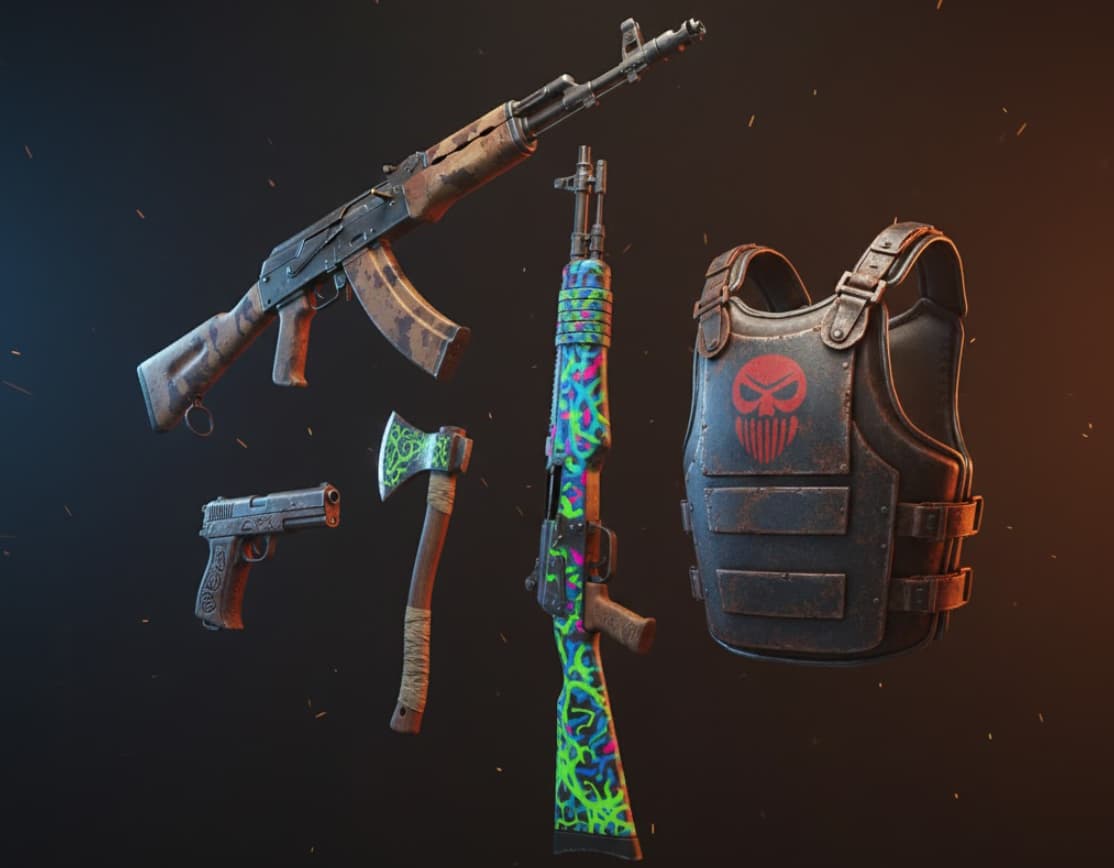
Rust skins modify weapon, tool, clothing, and building appearances cosmetically.
They provide zero functional advantages. All gameplay mechanics remain identical regardless of visual customization.
Skins persist in the Steam inventory across server wipes. Losing in-game progress during wipes doesn’t affect skin ownership.
Items remain accessible permanently unless manually traded or deleted.
Rarity classifications determine base value: Consumer Grade, Industrial Grade, Mil-Spec, Restricted, Classified, Covert, and Contraband.
Market prices fluctuate based on supply, community demand, and item age beyond rarity alone.
Steam controls all legitimate inventory transactions. No external service can add items directly to inventories.
Any claim otherwise indicates a scam operation.
How to Use Rust Skins?
Apply skins through the Steam inventory while connected to any Rust server:
- Access the inventory interface in-game
- Select the item category requiring skin application
- Choose from owned skins in your Steam inventory
- Confirm selection for future crafts
Applied skins affect only newly crafted items, not existing inventory. The selection persists until manually changed.
Server compatibility is universal—all official and community servers recognize Steam inventory skins.
Security note: Never use third-party applications claiming to “apply skins faster” or “unlock premium skins.”
These are malware designed to steal account credentials.
How to get skins in Rust just by playing?: The Reward System
Facepunch operates a weekly drop system rewarding active accounts.
Drops are distributed every Thursday to players meeting minimum weekly playtime thresholds.
The system requires no external site interaction or account linking beyond standard Steam login.
| Method | Cost | Drop Frequency | Typical Value | Risk Level |
|---|---|---|---|---|
| Weekly Drops | Free | Once per week | $0.03–$0.50 | None |
| Seasonal Events | Free | Limited periods | $0.50–$5.00 | None |
| Twitch Campaigns | Free | During active campaigns | $1.00–$10.00 | None (with proper linking) |
This represents the safest method to accumulate free Rust skins for beginners.
Zero fraud exposure exists because the system operates entirely within Valve’s infrastructure.
No external websites, trades, or verification steps can compromise your account.
Drop value expectations should remain conservative. Most weekly drops contain Consumer or Industrial Grade items worth under $1.
Accumulation over months builds modest collections without financial or security risk.
Security benefit: This method teaches skin system mechanics without exposing you to scam tactics common in trading or third-party sites.
Buying on the Steam Community Market: Safety and Reliability
Steam’s official marketplace provides maximum transaction security through Valve’s infrastructure.
All payments are processed through Steam Wallet using established payment methods already verified for your account.
| Aspect | Security Advantage | Limitation |
|---|---|---|
| Transaction Safety | Valve authentication required | No external payment reversal |
| Account Protection | Two-factor verification enforced | 15-day trade hold on new devices |
| Fraud Prevention | Buyer and seller ratings are visible | Higher prices due to combined fees |
| Inventory Control | Instant delivery to inventory | Funds locked to the Steam ecosystem |
The Rust item store concept exists through Steam’s marketplace rather than a dedicated in-game shop.
All legitimate purchases occur through Steam’s systems or API-authorized third-party platforms.
Security protocol: Steam requires two-factor authentication for marketplace transactions.
Enable Steam Guard Mobile Authenticator before making purchases. Email-based authentication provides weaker protection against account compromises.
Price premiums of 15-30% compared to third-party sites pay for complete fraud protection.
This trade-off benefits players prioritizing security over savings.
Buying on third-party sites: cost-effective, but be careful
Third-party marketplaces reduce costs through lower fee structures but introduce verification requirements and increased fraud exposure.
Savings range from 15-40% compared to Steam pricing on identical items.
| Factor | Low Risk Scenario | High Risk Scenario |
|---|---|---|
| Platform Reputation | 2+ years of operation with verified review history | New site with minimal online presence |
| Payment Protection | Card with chargeback rights or PayPal | Cryptocurrency only or wire transfer |
| Authentication Method | OAuth through official Steam | Password requests or “security verification” |
| Trade Delivery | Standard Steam trade offer system | Account access requests or API key abuse |
| URL Verification | Exact match to known legitimate domain | Similar domain with character substitution |
| Customer Support | Responsive support with ticket history | No support or automated responses only |
Security protocol for third-party purchases:
- Verify the exact URL spelling before entering any information
- Use OAuth authorization only—never provide your Steam password
- Enable trade confirmations through Steam Guard Mobile
- Check seller/platform reputation through independent review sites
- Start with small test purchases before large transactions
Trade delivery occurs through Steam’s official trade system. You receive a trade offer that you must manually accept. Legitimate platforms never request account passwords, email access, or Steam Guard codes.
Trading with other players
Peer-to-peer trading carries the highest scam exposure of all acquisition methods. Scammers operate extensively in trading communities using sophisticated social engineering and technical exploits.
Common fraud patterns to recognize:
- Impersonation: Fake admin or middleman accounts with similar names to trusted users
- Phishing links: Malicious sites designed to steal credentials through fake Steam login pages
- Bait-and-switch: Showing a high-value item in chat, offering a different item in the actual trade
- Middleman scams: Scammer suggests using their “trusted friend” as escrow
- API scams: Requesting API keys that grant full inventory control
- Fake payment proof: Edited screenshots claiming payment sent
Safety protocols for trading:
- Use only established marketplace escrow systems
- Verify all URLs manually before clicking
- Never trade with accounts under 6 months old
- Check the trade partner’s Steam profile for VAC bans and trade ban history
- Use Steam’s built-in trade system only
- Never share Steam Guard codes or API keys
Risk assessment: Even with precautions, player trading maintains elevated risk. Consider whether potential savings justify exposure compared to secure marketplace purchases.
How to get free skins in Rust 2026 via Events and Contests?
Developer and community events provide free acquisition opportunities with varying risk levels.
Official Facepunch events carry zero risk while community contests require verification of organizer legitimacy.
| Event Type | Cost | Effort Required | Reward Type | Risk Level |
|---|---|---|---|---|
| Facepunch Seasonal Events | Free | Medium (5-10 hours) | Exclusive event skins | None |
| Official Twitch Drops | Free | Low (passive viewing) | Campaign-specific items | None |
| Verified Community Contests | Free | Variable (submissions) | Donated items | Low |
| Streamer Giveaways | Free | Low (follow/sub) | Random raffle | Low |
Twitch drops require linking your Steam and Twitch accounts through official authorization pages.
Verify you’re on Twitch.tv and Steampowered.com domains before authorizing. Fake linking sites steal both accounts simultaneously.
Official event security: Facepunch events require only standard gameplay on official or community servers.
No external linking, registration, or verification occurs outside Steam’s normal login system.
Community contest safety indicators:
- Organizers have verified social media presence for 6+ months
- Previous giveaway winners publicly announced with proof
- No requirements to deposit items, share credentials, or pay fees
- Clear contest rules are posted publicly
- Winners contacted through official platform messages, not suspicious DMs
Red flags indicating fake contests:
- “Entry fee” or “processing fee” requirements
- Requests for Steam password or Guard codes
- Pressure to “verify” through external websites
- Too-good-to-be-true prize values
- New accounts with no posting history are organizing giveaways
How to get skins on Rust servers?: Truths and Myths
Server-based acquisition claims require extreme skepticism. The Rust server architecture cannot add items to Steam inventories.
Any claim otherwise indicates either misunderstanding or deliberate fraud.
Myth: Servers can generate free skins for players
Fact: Only Valve controls Steam inventory additions through official systemsMyth: Playing on specific servers increases drop rates
Fact: Drop rates are account-based, not server-based; no server increases official drop probabilityMyth: Server plugins give admins inventory control
Fact: Server plugins cannot modify Steam inventories under any circumstancesMyth: Skin gambling sites offer legitimate winning opportunities
Fact: These violate Steam ToS, operate rigged systems, and frequently steal deposited itemsMyth: “Verification” processes unlock free skins
Fact: Verification requests are phishing attempts to steal account credentials
Legitimate server giveaways exist but follow strict patterns. Admins purchase skins personally and distribute them through manual Steam trades from their verified accounts. No automation, no deposit requirements, no credential requests.
Fraud warning signs from servers:
- Requiring item deposits before receiving prizes
- “Roulette” or “jackpot” gambling mechanics
- Requests for account passwords or API keys
- Links to external “verification” websites
- Promises of free high-value items for minimal effort
Which method should you choose for your collection?
Selection prioritizes risk tolerance before considering cost or time investment. Security-conscious players should default to zero-risk methods regardless of slower accumulation rates.
| Player Type | Best Method | Cost | Risk |
|---|---|---|---|
| Risk-averse beginner | Weekly drops + Steam Market | Free to $5+ | None |
| Active player with time | Weekly drops + official events + verified Twitch drops | Free | None |
| Buyer prioritizing security | Steam Market exclusively | $5–$100+ | None |
| Cost-conscious buyer | Verified third-party marketplaces with protocols | $3–$80+ | Low (with verification) |
| Experienced trader | Established marketplace escrow only | Variable | Medium |
Beginners should establish security habits before exploring managed-risk methods.
Start with weekly drops and Steam Market purchases to learn the system without exposure.
Once comfortable identifying scam patterns, carefully vetted third-party platforms become viable.
Never proceed with any transaction that triggers uncertainty.
Legitimate platforms and traders accommodate verification requests. Pressure tactics always indicate fraud attempts.
FAQs
- How to Get Skins in Rust without risking my account?
Use only weekly drops, Steam Market purchases, and official Facepunch events. These carry zero account compromise risk because they operate entirely within Valve’s protected systems.
- Are third-party marketplaces safe?
Established platforms with 2+ years of operation and verified reviews can be safe with proper verification protocols. Never use sites requesting passwords or lacking OAuth authentication.
- Can I get banned for using skin gambling sites?
Yes. These violate Steam’s Terms of Service. Participation risks trade bans or account restrictions, even if you don’t lose items directly.
- How do I verify a legitimate Twitch drops campaign?
Check Rust’s official Twitter and Facepunch blog for campaign announcements. Verify on Twitch.tv/drops page. Never authorize linking through third-party sites claiming to offer drops.
- What should I do if I clicked a phishing link?
Immediately change your Steam password, revoke API keys in account settings, and enable Steam Guard Mobile Authenticator. Contact Steam Support if items were stolen.
Conclusion:
Understanding how to get Rust skins in 2026 requires prioritizing account security over acquisition speed. Risk-free methods exist for all player types willing to accept slower accumulation rates.
Safest acquisition paths:
- Weekly drops provide steady zero-risk accumulation through standard gameplay
- Steam Market offers complete transaction protection despite higher prices
- Official events grant exclusive items without external site exposure
- Verified third-party platforms require strict security protocols, but reduce costs
Risk control essentials:
- Never share passwords, Guard codes, or API keys under any circumstances
- Verify all URLs manually before clicking or entering information
- Recognize that unrealistic offers always indicate fraud attempts
- Use established platforms with verified long-term reputations
Red flags requiring immediate rejection:
- Credential requests in any form
- Deposit requirements before receiving items
- Pressure tactics or artificial urgency
- Promises dramatically exceeding realistic market values
Account security always matters more than any individual item value.
Start with zero-risk methods and only graduate to managed-risk options after establishing strong security practices and fraud recognition skills.
Also Check: