 by
by Some sports rivalries are about geography. Others are about championships.
This one is about a transaction made on January 5, 1920, and everything that followed from it.
The red sox vs new york yankees timeline runs for more than a hundred years.
It starts with a new ballpark and a lopsided trade. It runs through brawls in stadium tunnels, one-game playoffs decided by men who had no business hitting home runs, and the single most stunning comeback in American sports history.
What makes it different from every other rivalry isn’t the hatred — though there’s plenty — it’s the stakes.
Games between these two teams have decided pennants on the final day of the regular season, ended dynasties, and resurrected fan bases that had spent decades learning not to hope too hard. The scoreboard consequences have always been real.
Red Sox vs New York Yankees Timeline
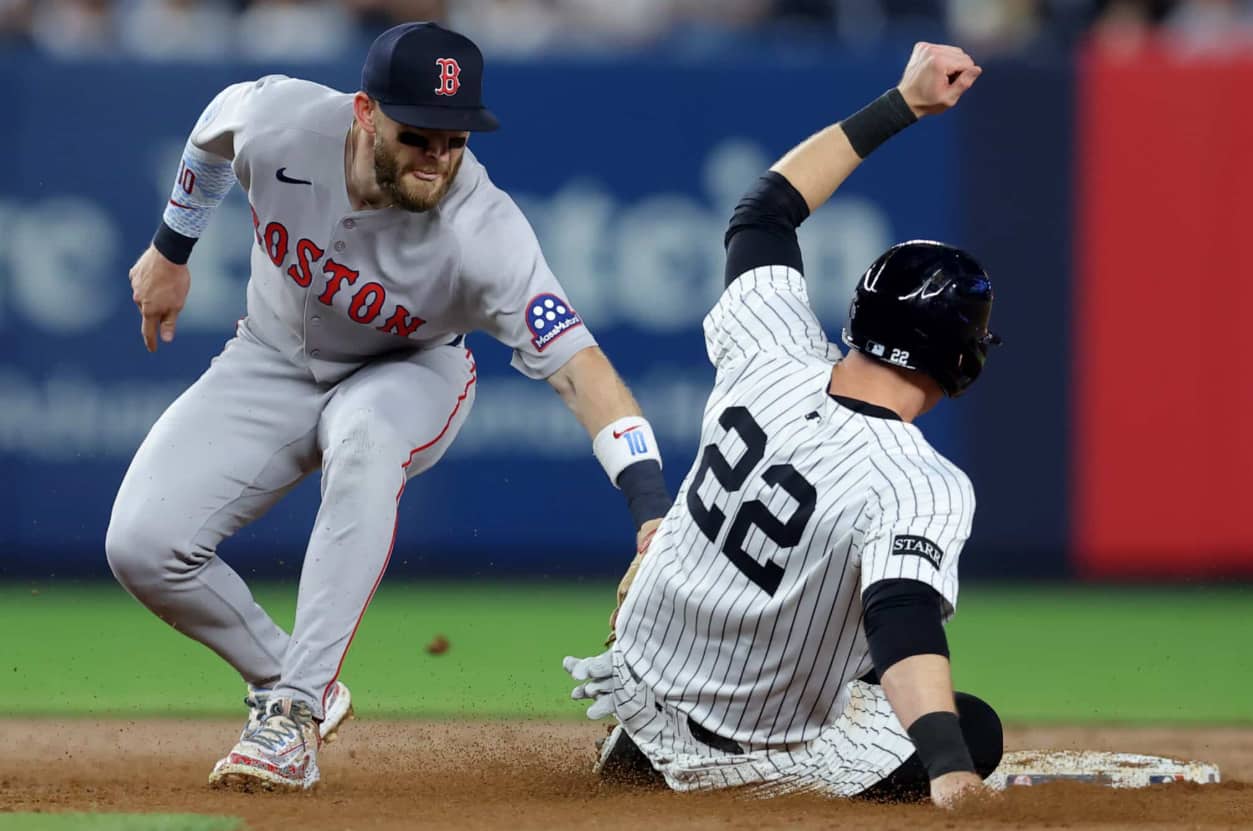
Here’s the full New York Yankees vs. Red Sox timeline, game by game, decade by decade, starting with the moment Fenway opened its gates and ending with a wild-card game that knocked out a Cy Young contender in six outs.
Red Sox vs Yankees Timeline: Full Game-by-Game Reference Table
| Date | Game / Moment | Location | Winner | Score | What It Cost or Proved |
|---|---|---|---|---|---|
| Apr 11, 1912 | Yankees wear pinstripes for first time — Opening Day vs. Red Sox | New York | Red Sox | 5–3 | The uniform that defined a franchise debuted in a loss to Boston |
| Apr 20, 1912 | Fenway Park opens — Red Sox vs. Yankees | Fenway Park | Red Sox | 7–6 (12 inn.) | Tris Speaker walk-off single; Boston won the World Series that fall |
| May 6, 1915 | Babe Ruth hits first career home run — off Jack Warhop | Polo Grounds | Yankees | 4–3 (13 inn.) | Ruth was 20, still a Red Sox pitcher; homered in just his 18th plate appearance |
| Jan 5, 1920 | Red Sox sell Babe Ruth to the Yankees for $100,000 | — | — | — | Boston went 86 years without a World Series title; New York won four with Ruth |
| Apr 18, 1923 | Yankee Stadium opens — Red Sox are first opponent | Yankee Stadium | Yankees | 4–1 | Ruth hit the stadium’s first home run against his former team; 74,000 in attendance |
| May 30, 1938 | Cronin-Powell fight on the field — then in the tunnel beneath the stadium | Yankee Stadium | Yankees | 7–4 (Game 1) | Widely cited as the moment genuine animosity between the clubs took hold |
| Jul 9, 1939 | Red Sox win both ends of Yankee Stadium doubleheader | Yankee Stadium | Red Sox | 4–3 / 5–3 | 5th straight NY loss in the series after trailing by 13.5 games; Boston still lost division by 17 |
| Jul 2, 1941 | DiMaggio breaks Willie Keeler’s consecutive-game hit streak — vs. Red Sox | Yankee Stadium | Yankees | — | Sixth-inning homer pushed streak to 45; DiMaggio finished at 56 |
| Oct 3, 1948 | Red Sox beat Yankees 10–5 on final day — eliminate NY from pennant race | Fenway Park | Red Sox | 10–5 | Boston knocked out NY then lost a one-game playoff to Cleveland the next day |
| Oct 2, 1949 | Yankees beat Red Sox on final day to win pennant by one game | Yankee Stadium | Yankees | 5–3 | Ellis Kinder ran out of gas in the 7th; first of five straight NY pennants |
| Sep 28, 1951 | Allie “Superchief” Reynolds no-hits Red Sox — his second no-hitter that season | Yankee Stadium | Yankees | 8–0 | Reynolds retired Ted Williams, Dom DiMaggio, Johnny Pesky, and Lou Boudreau |
| Sep 10, 1967 | Yastrzemski’s Red Sox beat Yankees 9–1 in pennant race — 7th win in 8 tries | Fenway Park | Red Sox | 9–1 | Boston won 7 of 8 vs. NY across a 14-day stretch; the “Impossible Dream” season |
| Sep 8, 1972 | Tiant shuts down Yankees 4–2 to complete sweep | Fenway Park | Red Sox | 4–2 | Boston finished 4–1 vs. NY in September; lost division to Detroit by half a game |
| Aug 1, 1973 | Munson vs. Fisk brawl at home plate — both ejected; Boston wins it anyway | Fenway Park | Red Sox | Walk-off | Backup Bob Montgomery drove in the winner after both starting catchers were tossed |
| May 20, 1976 | Pudge and Piniella collide; Mickey Rivers knocks out Bill Lee’s shoulder | Yankee Stadium | Red Sox | 8–2 | Lee missed nearly two months; Boston won the game but not the pennant |
| Jun 18, 1977 | Martin pulls Reggie Jackson mid-inning on national TV; dugout nearly erupts | Fenway Park | Red Sox | 10–4 | Nationally broadcast Saturday game; Sox swept the three-game series |
| Sep 14, 1977 | Reggie Jackson walk-off two-run homer in the 9th off Reggie Cleveland | Yankee Stadium | Yankees | 2–0 | Boston was 2.5 games back; never recovered as NY won the division by 2.5 |
| Sep 7–10, 1978 | The Boston Massacre — NY outscores Boston 52–9 in four games at Fenway | Fenway Park | Yankees (sweep) | 15–3 / 13–2 / 7–0 / 7–4 | Erased a 4-game Boston lead; NY had trailed by 10 games in July |
| Oct 3, 1978 | One-game playoff — Bucky Dent home run over Green Monster in 7th | Fenway Park | Yankees | 5–4 | Dent had 3 HR all season; his shot off Mike Torrez became the rivalry’s most painful image |
| Jul 4, 1983 | Dave Righetti no-hits Red Sox on Steinbrenner’s birthday — Independence Day | Yankee Stadium | Yankees | 4–0 | Righetti retired Wade Boggs for the final out; Steinbrenner watched from his box |
| May 27, 1999 | Roger Clemens faces Red Sox for first time as a Yankee | Yankee Stadium | Yankees | Win | Former Boston ace went 7 innings, 2 hits; Red Sox fans were not okay with this |
| Oct 13, 1999 | ALCS Game 1 — Bernie Williams walk-off homer in the 10th off Rod Beck | Yankee Stadium | Yankees | Walk-off | First postseason meeting in rivalry history; NY won the series 4–1 |
| Oct 16, 1999 | ALCS Game 3 — Pedro strikes out 12 Yankees in 7 shutout innings | Fenway Park | Red Sox | 13–1 | Pedro’s 23–4 / 2.07 ERA season at its most visible; Boston’s lone win of the series |
| May 28, 2000 | Pedro vs. Clemens — first head-to-head start; scoreless until the 9th | Yankee Stadium | Red Sox | 2–0 | Trot Nixon two-run homer off Clemens in the 9th; Pedro escaped bases loaded to end it |
| Oct 11, 2003 | ALCS Game 3 brawl — Don Zimmer charges Pedro; Pedro sidesteps him | Fenway Park | — | — | 72-year-old Yankee bench coach charged the field; one of the rivalry’s strangest images |
| Oct 16, 2003 | ALCS Game 7 — Aaron Boone walk-off homer in 11th off Tim Wakefield | Yankee Stadium | Yankees | Walk-off | Grady Little left a tired Pedro in the 8th; NY tied it; Boone ended 84 years of hope |
| Apr 16, 2004 | ARod’s first game at Fenway as a Yankee — Fenway boos constantly | Fenway Park | Red Sox | 6–2 | An offseason Boston-ARod deal had collapsed; John Henry called NY “the evil empire” |
| Jul 24, 2004 | Varitek-ARod altercation; Mueller walk-off homer off Rivera in the 9th | Fenway Park | Red Sox | Walk-off | Rivera blown twice in same game; Mueller’s homer became a turning point for 2004 Boston |
| Oct 17, 2004 | ALCS Game 4 — Roberts steals 2nd; Mueller ties it; Ortiz walk-off HR (12 inn.) | Fenway Park | Red Sox | Walk-off HR | Down 3–0 in the series; baseball’s most consequential stolen base |
| Oct 18, 2004 | ALCS Game 5 — Ortiz walk-off single in the 14th; Wakefield throws 3 relief innings | Fenway Park | Red Sox | Walk-off | Big Papi with back-to-back walk-off wins in elimination games |
| Oct 19, 2004 | ALCS Game 6 — Schilling’s bloody sock; ARod slapped ball ruled interference | Yankee Stadium | Red Sox | 4–2 | Umpires reversed ARod call; Boston fans watching Yankee Stadium throw garbage on the field |
| Oct 20, 2004 | ALCS Game 7 — Red Sox win pennant at Yankee Stadium; 6 runs in first 2 innings | Yankee Stadium | Red Sox | 10–3 | First team ever to come back from 3–0 in any MLB postseason series |
| Oct 1, 2005 | Yankees win AL East at Fenway — celebrate on Boston’s field | Fenway Park | Yankees | — | New York’s 8th straight AL East title; the celebration on enemy turf rubbed salt in the wound |
| Oct 2–3, 2010 | Red Sox deny Yankees AL East title in final weekend | Fenway Park | Red Sox | Walk-off (Game 2) | NY forced to wild card; lost to Texas in the ALCS |
| Sep 28, 2011 | Red Sox September collapse — Papelbon blows 2-out, none-on lead in the 9th | Baltimore | Orioles | 4–3 | Boston lost wild card on the final night of the season; Francona gone within weeks |
| Aug 18, 2013 | Dempster intentionally hits ARod; Rodriguez homers 442 feet to center | Fenway Park | Yankees | 9–6 | ARod was playing through a Biogenesis suspension appeal; Dempster admitted it was intentional |
| Sep 28, 2014 | Jeter’s last at-bat at Fenway — RBI single in the 6th; Fenway stands | Fenway Park | — | — | His 3,465th hit; Fenway’s standing ovation for a Yankee remains one of baseball’s more human moments |
| Oct 5, 2021 | Wild Card Game — Red Sox beat Yankees 6–2; Cole lasts 6 outs at Fenway | Fenway Park | Red Sox | 6–2 | First-ever rivalry wild card game; Boston ended New York’s season at home |
The Transaction That Started Everything
Strip away all the brawls and walk-off homers for a moment, and the Yankees and Red Sox timeline starts in a very simple place: a cash-strapped owner, a club that needed money, and a player too good to be measured against the rest of his era.
Boston owner Harry Frazee sold Babe Ruth to the Yankees on January 5, 1920, for $100,000 and a $300,000 loan against Fenway Park as collateral.
Ruth had pitched and hit the Red Sox to three World Series titles. He’d hit his first career home run at the Polo Grounds against the Yankees in 1915 — a third-inning shot off Jack Warhop in just his 18th major league plate appearance.
The sportswriter Damon Runyon was there and called him “quite a demon pitcher and demon hitter when he connects.”
The Yankees connected Ruth to four more championships. Boston didn’t win another one until 2004.
When Yankee Stadium opened on April 18, 1923, Ruth hit the first home run ever struck in that building — against his former team, naturally, in a 4–1 New York win.
The headline writers called it “The House That Ruth Built.” What they didn’t mention was which team had sold him the lumber.
These early games set up everything that followed. Boston was good. New York was great. And the ledger between them would stay out of balance for most of the next eight decades.
How It Got Personal: The 1938 Brawl
Most sports rivalries become rivalries through proximity and competition. This one added a personal dimension in a stadium tunnel on Memorial Day, 1938.
A holiday doubleheader at Yankee Stadium. Red Sox pitcher Archie McKain threw at Yankees outfielder Jake Powell.
Powell charged the mound and was intercepted by Boston shortstop Joe Cronin, who was not in a patient mood — his team was trailing 7–0. Cronin threw the first punch. Both players were ejected.
The fight didn’t stop. It moved into the tunnel beneath the stadium, where Cronin reportedly knocked Powell out with a punch to the jaw.
What started as a reaction to a brushback pitch became something that felt, as Cronin reportedly put it later, personal.
This was the game most historians credit with turning a competitive relationship into a genuine hatred. The teams had been rivals before. After this, they were enemies.
Pennant Races and Near Misses: 1939–1967
For most of this stretch, the Yankees were simply better. Twelve pennants between 1950 and 1964. Five straight from 1949 to 1953.
The Red Sox were a team that could beat New York in any given series but couldn’t sustain it over a full season.
The 1949 final day is still the clearest example. Boston used an 11-game winning streak in September to pull into a tie with the Yankees entering the 154th game.
Manager Joe McCarthy put the ball in the hands of Ellis Kinder, a 23-game winner who had been used in relief three times in the four days prior.
Kinder left in the seventh with his team trailing 1–0. The bullpen gave up a homer in the eighth. The Yankees won 5–3.
DiMaggio’s 56-game hit streak passed through Boston’s hands twice — on July 2, 1941, when he reached 45 straight (breaking Willie Keeler’s record with a sixth-inning homer at Yankee Stadium), and later during the stretch when he kept going.
Ted Williams hit .406 that same season, the last player to do it. DiMaggio, hitting .357 in the regular season, won the MVP anyway. Williams finished second. These two teams couldn’t even give away individual awards without competing.
The 1967 season was the first time in years the Red Sox were genuinely in a pennant race deep into September, and they handled the Yankees accordingly — winning seven of eight meetings in 14 days, including a 9–1 win on September 10 that showed exactly what this rivalry looked like when both teams mattered.
Bodies on the Field: 1973–1978
The 1970s were the era when the rivalry got physical in ways that still get replayed whenever someone wants to illustrate what “genuine hatred” looks like on a baseball field.
August 1, 1973. Thurman Munson was waved home on what should have been a clean steal, except batter Gene Michael had missed the suicide squeeze sign and was still standing in the box when Munson barreled in.
Carlton Fisk applied the tag with all three players tangled at the plate. Munson shoved. Fisk hit back. Both were ejected. Bob Montgomery, Fisk’s backup, drove in the winning run in the bottom of the ninth off Sparky Lyle.
May 20, 1976. Lou Piniella tried to score from second on a single to right field. Dewey Evans threw it on a line to the plate. Fisk blocked it and made the tag. Piniella took exception.
Benches cleared. Mickey Rivers punched Bill Lee in the back of the head, sending the pitcher to the ground with a separated shoulder. Lee missed nearly two months. Boston won the game 8–2. The Yankees won the pennant.
And then came 1978 — the one that Boston fans still can’t fully explain even now.
On September 1st, the Red Sox led the AL East by six and a half games. New York replaced manager Billy Martin with Bob Lemon.
Boston went cold. On September 7 through 10, the Yankees came to Fenway for what should have been a competitive four-game series and produced 52 runs to Boston’s nine across two doubleheader sweeps.
The lead was gone. Both teams finished tied, which forced Game 163.
At Fenway. On October 3. Bucky Dent, who had hit three home runs all season, pulled a Mike Torrez fastball just over the Green Monster with two on in the seventh inning.
Three runs scored. New York won 5–4. Dent’s middle name acquired a new version in Boston that day, and it has never fully faded.
Pedro, Clemens, and Five Years of October Theater
When the expanded playoff format finally gave these two clubs a postseason stage, they filled it.
The 1999 ALCS opened at Yankee Stadium with Bernie Williams walking off a Rod Beck slider in the tenth inning of Game 1.
The Yankees won the series 4–1, but Boston made them earn Game 3 — Pedro Martinez threw seven shutout innings with 12 strikeouts, and the Red Sox won 13–1.
On a staff full of excellent pitchers, nobody made New York look helpless quite the way Pedro did in that building.
Roger Clemens on the other side was the natural counterweight. He’d been Boston’s ace for 13 seasons.
When New York acquired him by trade in 1999, the reunion — if that’s even the right word — was tense by design. Their first direct matchup came on May 28, 2000.
Clemens vs. Martinez, Yankee Stadium, scoreless through eight. In the ninth, Trot Nixon hit a two-run homer off Clemens.
Pedro loaded the bases in the bottom half and got Tino Martinez to ground out. Red Sox 2, Yankees 0. Pedro, in Clemens’ building.
2003 Game 7 negated all of it. Grady Little left a clearly exhausted Pedro Martinez on the mound in the eighth inning with a 4–1 lead and got punished for it.
The Yankees scored three. Tied game. In the 11th, Aaron Boone got into a Tim Wakefield knuckler that didn’t move and sent it over the left-field wall. Yankees in the World Series. Little was fired within days.
The only thing more stunning than what Boone did in 2003 was what Boston did in response a year later.
2004: The Reversal
David Ortiz won Games 4 and 5 of the 2004 ALCS in walk-off fashion — back to back — to keep Boston alive.
That’s remarkable on its own. What made it matter was what happened in Game 4 before Ortiz got to the plate.
Kevin Millar walked off Mariano Rivera. Dave Roberts, running for Millar, took off for second on the first pitch and beat the throw. Bill Mueller singled him home to tie it. None of that happens if Rivera gets Millar out. None of it.
Game 6 at Yankee Stadium. Curt Schilling had a dislocated tendon in his ankle sutured to the bone in a procedure the Red Sox medical staff had improvised specifically to get him through this start.
His sock was soaked red by the middle innings. He threw seven. Led 4–2 entering the eighth.
ARod tried to slap the ball out of Bronson Arroyo’s glove, running to first. The umpires called him out after a long conference. The Yankees fans threw debris on the field. Boston held on.
Game 7 was never close. Six runs in the first two innings. Final score 10–3. The Red Sox celebrated on the Yankee Stadium infield.
The first team in baseball history — in the history of any North American professional sport — to come back from three games down in a postseason series.
They won the World Series that October. The 86-year drought ended.
After 2004: Still Matters, Just Differently
The existential weight shifted after 2004. Boston won three more World Series titles by 2018. The losses still sting, but they no longer carry that particular flavor of generational dread.
The 2011 collapse is its own kind of infamous. On the final night of the season, with the Red Sox needing a win to hold their wild card spot, Jonathan Papelbon walked to the mound in the ninth inning at Baltimore with a 3–2 lead, two outs, and nobody on base.
The Orioles scored twice. The Rays won the wild card on the same evening. Boston’s lead, which had been nine games on September 1st, was gone. Francona was gone within weeks.
Derek Jeter’s farewell tour produced something genuinely unusual for this rivalry.
On September 28, 2014, the final day of the season, Jeter batted in the sixth inning at Fenway, punched a high-hopper to third for an RBI single, and left to a standing ovation from a crowd that had spent twenty years booing him.
His 3,465th career hit. Some of the Fenway crowd stood. Enough that it was audible and real.
On October 5, 2021, the first-ever rivalry wild card game was played at Fenway. Gerrit Cole started for New York. He allowed two home runs in three innings and was pulled after recording six outs.
Boston won 6–2. New York’s season ended at Fenway, at the hands of a team that had spent the summer knocking on the wild card door, and the moment that ended it was a pitcher who was supposed to be untouchable getting touched immediately.
FAQs
- Q: When did the Red Sox vs Yankees rivalry actually start?
The teams have played each other since the early 1900s, but the rivalry’s defining start point is January 1920, when Boston sold Babe Ruth to New York. The 1938 brawl between Joe Cronin and Jake Powell is often cited as the moment it became genuinely personal between the clubs.
- Q: What is the most painful loss in Red Sox history against the Yankees?
Most Boston fans cite October 3, 1978 — the Bucky Dent game — or Game 7 of the 2003 ALCS on the Aaron Boone walk-off homer. Both followed massive collapses, which made the individual moments hit harder than they would have in isolation.
- Q: What exactly happened with Dave Roberts in the 2004 ALCS?
With Boston trailing 4–3 in the ninth inning of Game 4, Kevin Millar walked off Mariano Rivera. Dave Roberts pinch-ran and stole second on the first pitch. Bill Mueller singled him home to tie the game. Ortiz hit a walk-off homer in the 12th. Boston went on to win the series from 3–0 down — no team in baseball history had done it before.
- Q: How many times have the Red Sox and Yankees met in the postseason?
Four times: the 1999 ALCS (Yankees won 4–1), the 2003 ALCS (Yankees won 4–3 on Aaron Boone’s Game 7 homer), the 2004 ALCS (Red Sox won 4–3 coming back from 3–0), and the 2021 AL Wild Card Game (Red Sox won 6–2).
- Q: Why did Curt Schilling’s sock turn red in the 2004 ALCS?
Schilling had a dislocated peroneal tendon in his ankle — an injury that would normally end his season. Red Sox team physician Bill Morgan used sutures to tack the tendon in place, a procedure improvised specifically for the postseason. The sutures bled through the sock during Game 6. Schilling threw seven innings and left with Boston leading 4–2.
- Q: What was the “Boston Massacre” in the Yankees-Red Sox rivalry?
A four-game series at Fenway Park from September 7–10, 1978, in which the Yankees outscored Boston 52–9, including wins of 15–3, 13–2, 7–0, and 7–4. The series turned a 4-game Boston lead into a flat-footed tie and led directly to the one-game playoff that Bucky Dent’s home run decided.
Conclusion:
The red sox vs new york yankees timeline doesn’t have a tidy ending because it isn’t finished. The Ruth sale is still the origin.
The Bucky Dent game is still the sharpest wound for one fan base. The 2004 ALCS comeback is still the thing that rewired the rivalry’s emotional logic.
What the timeline shows, looked at honestly, is that these two clubs have spent a century producing games worth remembering – games that landed differently than regular baseball, games that people passed down to their kids the way you pass down debt or a last name.
The next chapter is already coming. It always is.
Also Check: