
 by
by A live score may show 132/4 after 16 overs, but that number does not explain whether the batting side is ahead, under pressure, recovering well or running out of time.
A scorecard may show strike rates, economy rates, extras and fall of wickets, but casual fans may not immediately know which numbers matter most.
This is where AI can play a useful role in cricket coverage. AI can help explain the match situation in plain language.
It can translate complex scorecards into short summaries, describe why a wicket matters, explain a revised target, highlight momentum shifts and help fans understand cricket without needing years of background knowledge.
The important point is that AI does not replace cricket knowledge or live data. It needs reliable information underneath: scores, wickets, overs, innings state, player stats, match format, result status and context.
How AI Can Help Explain Cricket Matches to New and Casual Fans?
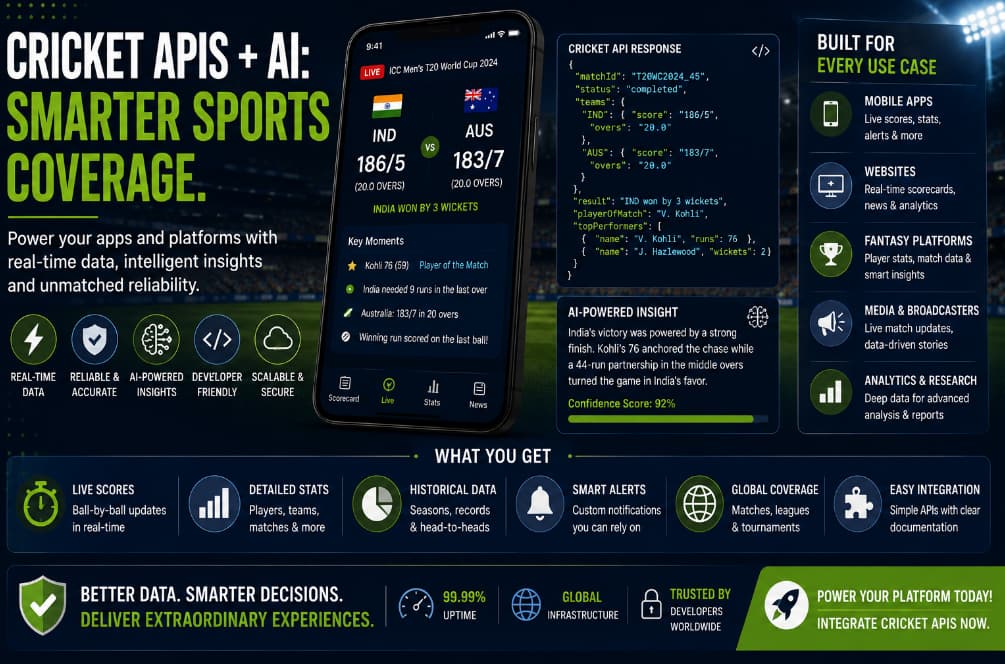
A platform using a structured Cricket API can provide the data layer AI needs to create clearer, more helpful fan experiences.
Why Cricket Can Feel Difficult for New Fans?
Cricket has a language of its own. Terms such as required run rate, economy rate, strike rate, powerplay, DLS, follow-on, net run rate, maiden over and fall of wickets are familiar to regular fans, but they can be confusing for someone learning the game.
The sport also has different formats. A Test match, one-day international and T20 match all use the same basic cricket skills, but the meaning of a score can change completely depending on the format.
Scoring 220 may be modest in a 50-over match, strong in some conditions, and irrelevant as a comparison in Test cricket.
Casual fans often understand the basics: runs, wickets and who is winning. The challenge is understanding context.
Is the chase easy or difficult? Is a batter scoring quickly enough? Is a bowler controlling the match despite taking only one wicket? Has the weather changed the equation? AI can help answer these questions quickly.
AI Can Translate Scores into Plain Language
A live cricket score can be dense. Experienced fans may immediately understand it, but newer fans may need interpretation. AI can turn a score into a simple explanation that describes the match state.
For example, instead of only showing “Team A need 48 from 30 balls with six wickets remaining,” an AI-powered explanation might say: “Team A are still in a reasonable position, but the next two overs are important. They have wickets in hand, but the required rate is starting to rise.”
That explanation does not replace the score. It adds meaning. It helps fans understand whether the batting side is comfortable, under pressure or somewhere in between.
These explanations are especially useful on mobile devices, where users may check scores quickly. A short AI summary can give them the context they need without forcing them to inspect every part of the scorecard.
Explaining Run Rate and Required Run Rate
Run rate is one of cricket’s most important ideas, but it is not always obvious to casual fans. A team scoring at 7 runs per over may be ahead in one match and behind in another. Required run rate adds another layer because it changes throughout a chase.
AI can help by explaining the equation in simple terms. If a team needs 72 from 48 balls, the system can describe it as a manageable chase. If the next four overs produce only 18 runs and a wicket, the AI can explain that pressure has increased because the required rate is now higher.
This is not about oversimplifying cricket. It is about helping fans read the match more easily. The numbers remain available for serious fans, while casual users get a plain-language guide to what those numbers mean.
AI Can Explain Why a Wicket Matters
Not every wicket has the same impact. Losing a lower-order batter near the end of an innings is different from losing a set opener during a chase. A wicket after a long partnership may shift momentum. A wicket at the start of a powerplay may change a team’s entire approach.
AI can help explain the importance of a wicket by looking at the match situation. It can consider who got out, how many wickets remain, how many overs are left, the target and the current scoring rate.
A useful explanation might say: “That wicket matters because the set batter was controlling the chase. The new batter now has little time to settle, and the required rate is already above nine per over.”
For fans who are still learning cricket strategy, this kind of explanation can make the sport much easier to follow.
“Cricket is a pressure game, and when it comes to an India-Pakistan match, the pressure is doubled.”
— Imran Khan
Pressure is one of the hardest parts of cricket to understand from the score alone. AI can help make that pressure visible by explaining why certain moments feel bigger than others.
Helping Fans Understand Bowling Impact
Batting performances are often easier for casual fans to understand because runs are obvious. Bowling impact can be more subtle.
A bowler may take three wickets and clearly stand out, but another bowler may change the match by conceding very few runs at a crucial stage.
AI can explain bowling impact by looking beyond wickets. Economy rate, dot balls, phase of innings, pressure created and match situation all matter.
A spell of 0/18 in four overs may be extremely valuable in a T20 match if it slows the scoring rate and forces risks at the other end.
A good AI explanation might say: “Although the bowler has not taken a wicket, this spell has been important because it has reduced the scoring rate and forced the batting side to take more risks.”
This helps new fans appreciate cricket beyond the obvious highlights.
Making DLS and Rain-Affected Matches Easier to Follow
Rain delays and revised targets are among the most confusing parts of cricket for casual fans. A match can pause, overs can be reduced, targets can change and the final result can depend on rules that are not easy to understand at a glance.
AI can help by explaining what changed in plain language. Instead of only showing a revised target, a platform could say: “Rain has reduced the chase to 32 overs. The batting side now need 185, which means the required rate has increased.”
This kind of explanation requires accurate match status and revised-condition data. AI cannot explain a rain-affected match properly if it does not know the original target, revised target, overs available and official match state.
Teams building smarter cricket products can follow updates and product thinking through sections such as Cricket API news, especially as AI-assisted sports coverage becomes more common.
AI Can Personalize the Match Experience
Casual fans do not all need the same explanation. Some may want basic match context. Others may follow one team, one player or one tournament. AI can help personalize the experience so fans receive information that matches their interest level.
A beginner might receive a simple explanation of the current chase. A more engaged fan might receive a summary of the last five overs. A fantasy cricket user might receive player-specific updates. A fan following a favourite batter might get milestone alerts and form context.
Personalization works best when the data underneath is structured. The system needs to know teams, players, match state, score events and user preferences. AI can then turn those facts into more relevant updates.
AI Should Support Experts, Not Replace Them
AI explanations are most useful when they support the fan experience without pretending to replace expert commentary. Cricket has deep tactical and cultural knowledge that human commentators, analysts and writers bring to the game.
The best use of AI is to handle quick explanations, summaries and context that make the match easier to follow. It can help fans catch up, understand basic strategy and navigate a complex scorecard. Human experts can still provide deeper judgment, emotion and storytelling.
“Cricket is an art, like the theatre, ballet, opera or the dance.”
— C. L. R. James
That artistic side of cricket is why explanation matters. AI can help more fans access the game, but the sport’s richness still comes from the players, the contest and the stories around it.
Data Quality Decides Whether AI Is Helpful
AI can only explain cricket well when the underlying data is accurate. If the score is delayed, the explanation will be delayed.
If the match status is wrong, the AI may misunderstand the situation. If player names or scorecard fields are inconsistent, summaries may become confusing.
This is why sports platforms should treat cricket data quality as the foundation of AI. Clean live scores, scorecards, player stats, innings state and result information are essential. AI adds the language layer, but the data provides the truth.
Final Thoughts
AI can help explain cricket matches to new and casual fans by turning complex data into clear, readable context. It can explain run rates, wickets, bowling spells, revised targets, momentum shifts and player impact in a way that makes the game easier to follow.
This does not make traditional scorecards or expert commentary less important. Instead, AI adds another layer to cricket coverage. It helps fans who want quick understanding while still allowing deeper fans to explore full data and analysis.
As cricket platforms become smarter, the winners will be those that combine reliable data with useful explanation. A good cricket experience should not only show the score. It should help every fan understand why the match feels the way it does.