 by
by The last lap of a Formula 1 race is when preparation stops mattering, and decisions take over.
Tire choices made forty laps earlier either hold up or they don’t. Gaps that looked safe on the timing screen suddenly aren’t.
A driver who’d been managed conservatively finds they have to race again.
The greatest last-lap victories in Formula 1 are the races where all of that pressure landed on one lap, one corner, or one call — and someone got it right when getting it wrong would have been permanent.
Greatest Last-Lap Victories in Formula 1 History
Here are the ten that mattered most.
10 Greatest Last-Lap Victories in Formula 1
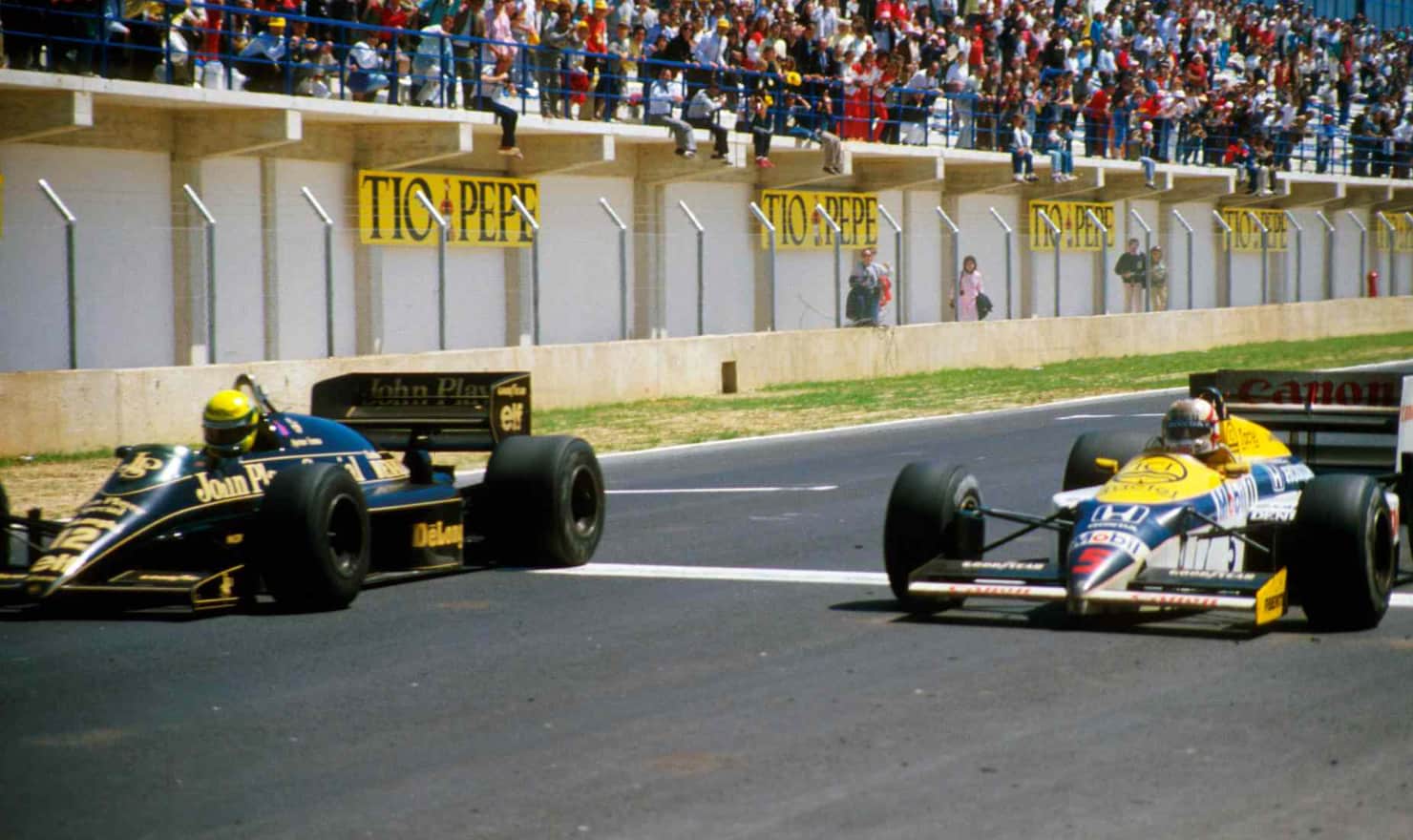
10. Spanish GP, 1986 — Senna and Mansell, 14 Thousandths of a Second
Fourteen thousandths is roughly the time it takes to blink. At Circuit de Catalunya in 1986, that’s the gap between Ayrton Senna and Nigel Mansell at the checkered flag after running side by side down the final straight. Senna had the inside. He kept it. The result stood, but only just — and only because Senna never gave Mansell the line he needed.
9. Hungarian GP, 2014 — Ricciardo Makes It Look Routine
Two overtakes on two former world champions in the final laps, at a circuit that doesn’t easily offer passing opportunities. Ricciardo went past Hamilton first, then Alonso, both moves clean and measured. The wins that look effortless are sometimes the hardest to pull off — Ricciardo was on the better tire, but the execution still had to be exact. It was.
8. Belgian GP, 2000 — Häkkinen Invents a New Kind of Overtake
The Kemmel Straight at Spa has witnessed some of F1’s greatest passes. None more studied than this one. Häkkinen closed on Schumacher with a backmarker between them, split the gap, and went around the outside in a single unbroken movement. Schumacher had nowhere to go and no time to adjust. The move is still used in driver coaching contexts as an example of reading space two or three seconds before it opens.
7. Monaco GP, 1992 — Senna Turns Monaco Into a Fortress
Mansell had the pace, the tires, and the time. What he didn’t have was a way through Senna, who defended every corner at Monaco for lap after lap without a single error. The final margin was two seconds. That number understates how completely Senna controlled the situation. Mansell was never close to making a pass; Senna made sure of it. A reminder that Monaco races aren’t always won by the fastest driver.
6. San Marino GP, 2005 — Alonso Wins by Taking Away Options
Imola, 2005. Schumacher was faster. Alonso made that irrelevant. Rather than trying to outpace the Ferrari, Alonso drove to deny it space — covering the lines, staying wide on the approaches, making every potential overtake marginally too difficult to attempt. Schumacher ran out of laps before he ran out of ideas. It was a tactically mature win from a 23-year-old who was clearly thinking several corners ahead throughout.
5. Canadian GP, 2011 — Button Outlasts a Four-Hour Race
The numbers from Montreal 2011 still read like a misprint. Six pit stops. A drive-through penalty. A four-hour race with a safety car period stretching into the record books. And at the end of it, Jenson Button on Vettel’s gearbox with one lap to go. Vettel, under relentless pressure, went wide at the hairpin. Button came through. A win that required surviving the race before racing in it.
4. Japanese GP, 1989 — A Chicane, a Collision, a Championship
Senna and Prost arrived at Suzuka in 1989 knowing the race would determine the title. They collided at the chicane. Senna restarted and took the win; he was disqualified afterward for the manner of his restart. Prost was champion. The debate over who was responsible for the collision has never been fully resolved, which may be the point — it was the kind of moment that two drivers who genuinely disliked each other were probably always going to produce.
3. Austrian GP, 2002 — The Win That Changed the Rules
The strangest entry on any list of last-lap F1 victories. Barrichello led and was the faster car. Ferrari ordered him, on the radio, in the final meters, to let Schumacher through. He moved over on the finish straight. Schumacher won by less than a car length. The FIA introduced explicit regulations on team orders the following year. This race is here not because the racing was good, but because it had consequences for every race that came after it.
2. Abu Dhabi GP, 2021 — Verstappen on Fresh Tires, One Lap, Everything on the Line
The sequence of events in the final ten minutes of the 2021 Abu Dhabi Grand Prix has been reconstructed and argued over more than almost any finish in recent memory. A late safety car. A contested decision on which lapped cars could clear before the restart. The result: Verstappen on new mediums directly behind Hamilton on heavily worn hards, one lap remaining, championship level. Verstappen passed at Turn 5 and held it. His first title. The FIA later confirmed the restart procedure wasn’t followed correctly. The pass itself was clean.
1. Brazilian GP, 2008 — The Last Corner of the Last Lap of the Season
Everything about the 2008 Brazilian Grand Prix final lap is almost impossibly specific. Hamilton needed fifth place. He was sixth. He caught Timo Glock — who had stayed out on dry tires as the track got damp — at the final corner of the final lap. He passed him. He had fifth. He was champion by one point.
Felipe Massa had crossed the line moments earlier, believing he’d won the championship. His team had already started celebrating. The photo that came out of that garage afterward — the moment the team realized Hamilton had made the pass — tells the story without needing a caption.
No finish in F1 history has balanced that level of precision timing against those stakes. Hamilton became champion in the last seconds of the last race. On the last corner.
What These Races Actually Have in Common?
Looking across all ten, the same conditions keep appearing.
Tire delta. In at least six of these races, the winning driver had a tire advantage in the final laps — either from a later stop, staying out longer, or reading the conditions correctly when others didn’t.
Fresher rubber doesn’t guarantee a win, but it creates the conditions for one.
Pressure and the response to it. Every driver who won these races made at least one correct decision under pressure that their rival didn’t. Senna covering Mansell’s line.
Alonso is reading Schumacher’s attack routes. Button is staying calm through a four-hour race.
The ability to make good decisions when the margin for error has gone is what separates these finishes from ordinary late-race passes.
Something is going unexpectedly wrong. Glock’s tires. Vettel’s moment at the hairpin. Schumacher had no response to Häkkinen’s split-second move.
Last-lap victories usually require the leading driver or car to give the chasing one a way in. Preparation creates opportunity; something has to open the door.
FAQs
- What counts as a last-lap victory in Formula 1?
Any race where the final result was determined on the last lap — through an overtake, a collision, a mechanical failure, or a position change that decided either the race win or the championship standings.
- Why does tire strategy create so many last-lap battles in F1?
Drivers who pit later for fresh rubber can have a significant pace advantage in the final laps. When that gap is enough to close on the leader but not enough to overtake cleanly earlier, it sets up exactly the kind of final-lap battle that appears throughout this list.
- What happened to Michael Masi after the 2021 Abu Dhabi Grand Prix?
The FIA’s post-race review confirmed that the safety car restart procedure was not followed correctly. Masi left his role as race director before the 2022 season. The FIA implemented structural changes to race direction afterward.
- Is the 1971 Italian Grand Prix the closest finish in F1 history?
Yes. Peter Gethin won the 1971 Italian Grand Prix at Monza by 0.01 seconds, with five cars finishing within 0.61 seconds. It remains the closest multi-car finish the sport has recorded.
- Which circuit produces the most last-lap drama in Formula 1?
Interlagos in Brazil appears more often in championship-deciding final laps than any other circuit. Beyond 2008, the track has hosted multiple title-deciding rounds and tends to produce unpredictable conditions late in races.
Conclusion:
The greatest last-lap victories in Formula 1 aren’t random.
They happen when tire strategy, circuit layout, and two drivers at the edge of their ability converge on the same final lap.
The races above each had a different combination of those elements, which is why each one feels distinct.
Hamilton at Interlagos is the one that will probably never be matched for sheer timing.
But every race on this list had a moment where the result could have gone differently — and didn’t.
Also Check: